Peak-End Rule in Product Design and Business
People remember the peak and the ending, not the average.

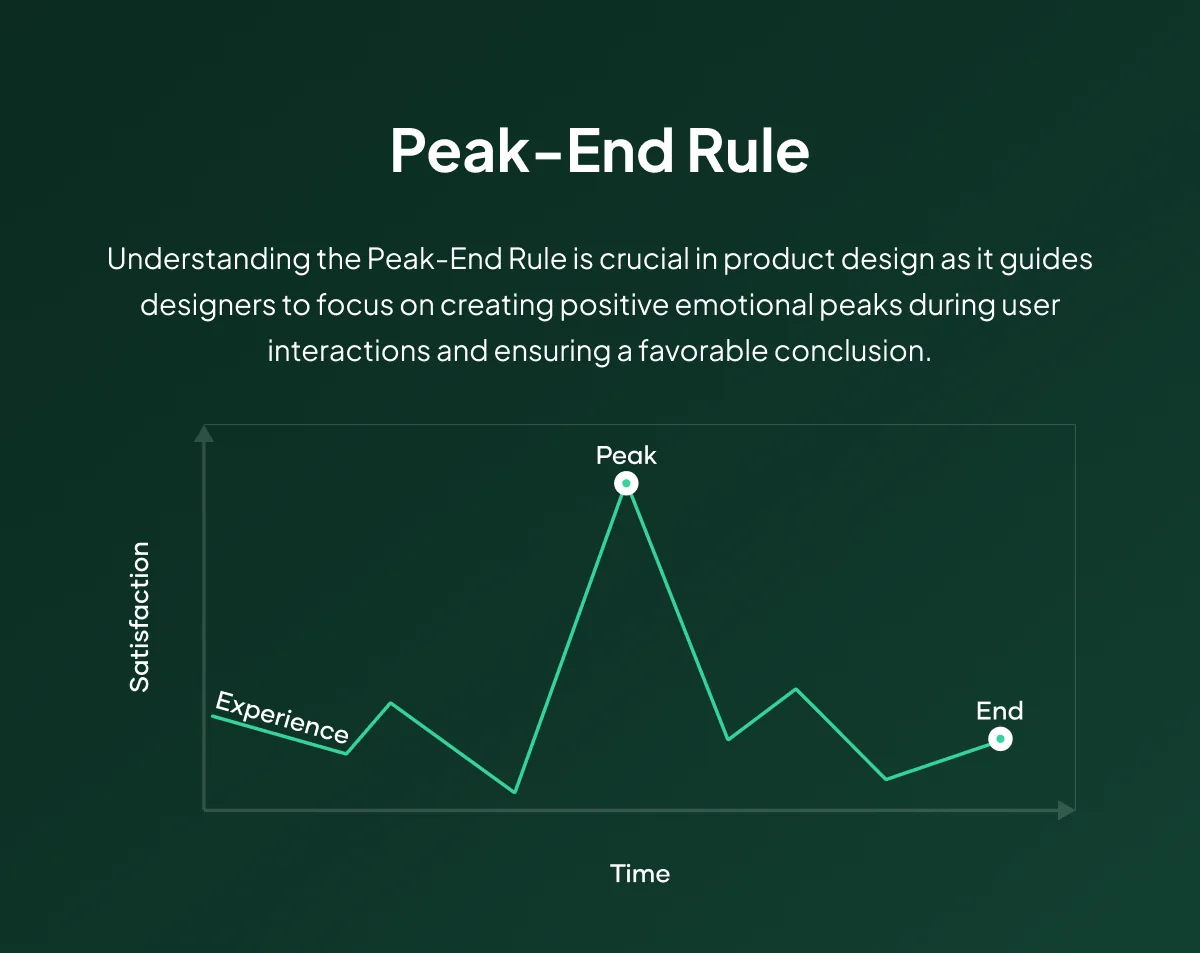
Coined by psychologists Daniel Kahneman and Barbara Fredrickson, this phenomenon suggests that our recollections are significantly influenced by the emotional peaks and conclusions of an experience rather than a comprehensive analysis of the entire path.
Defining the Peak-End Rule
At its core, the Peak-End Rule posits that the intensity of emotion at the highest point (peak) and the emotions felt at the conclusion (end) play a disproportionate role in shaping our overall memory of an event. This psychological principle has far-reaching implications, extending from personal experiences to critical applications in design, product development, and business strategies.
Why Does it Matter in Product Design?
The importance of the Peak-End Rule in product design cannot be overstated. Designers harness its principles to create user experiences that leave a lasting positive impact. By strategically placing positive emotional peaks throughout a user’s path and ensuring a favorable conclusion, designers can shape users’ perceptions and enhance overall satisfaction.
The Peak-End Rule — Tips
Additional Considerations
Acknowledging the psychological influence of peaks and endings grants designers a unique opportunity to mold user perceptions strategically. It’s a nuanced understanding that transcends functionality and looks at emotional resonance. Crafting experiences that align with the Peak-End Rule fosters satisfaction, builds user loyalty, and sets the stage for positive word-of-mouth.
Key Takeaways
- Emotional Impact: Designing for positive emotional peaks becomes paramount. Be it a celebratory animation or a reassuring message, these moments significantly influence how users perceive the overall experience.
- Lasting Impressions: The final moments of an interaction are etched deeply in memory. A positive conclusion reinforces the overall positivity of the experience, creating a lasting impression.
- UX Optimization: Applying the Peak-End Rule in user interface design is a potent strategy. Crafting interfaces that align with the user’s emotional path enhances engagement and memorability.
- Avoiding Negative Peaks: Recognizing that negative experiences are remembered more vividly, designers must work to minimize frustrating moments. A smooth and frustration-free path prevents negative lasting impressions.
- Consistent Application: The rule extends beyond product design, finding relevance in education, dining experiences, and various aspects of life. Understanding its consistent application allows for versatile and effective implementation.
Real-World Examples
Duolingo’s Language Learning Adventure
Duolingo, the language learning app, employs the Peak-End Rule ingeniously. Celebratory animations and positive reinforcements during language-learning milestones create emotional peaks.

Peak-End Rule Example — Duolingo
TurboTax’s Tax Filing Relief
TurboTax, the tax-filing application, takes advantage of the rule by acknowledging the relief users feel at the end of the taxing process.

Peak-End Rule Example — TurboTax
The Peak-End Rule encapsulates a deep understanding of human psychology that resonates across various domains. The rule offers a blueprint for creating meaningful and memorable interactions, from designing digital interfaces to the intricacies of educational practices and even the nuances of restaurant experiences.
Conclusion
As businesses navigate the complex landscape of customer engagement and product design, embracing the Peak-End Rule provides a strategic framework for success. It’s not merely about functionality but crafting experiences that leave an indelible mark on the user’s memory. By weaving positive emotional peaks and favorable conclusions into the fabric of design and business strategies, one can pave the way for enduring customer satisfaction and loyalty.
User Experience Consultancy at Olively
Feel free to seek personalized guidance on integrating the Peak-End Rule into your design and business strategies. I work with teams on decisions like this one.
Stay tuned for more insights by following me here and on my Medium page. Your path to crafting unforgettable user experiences begins with understanding the deep influence of the Peak-End Rule.
If you're weighing a decision like this on a live product, here's how I work with teams.
Part of the UX laws worth knowing — seventeen principles grouped by the decision each one helps you make.
Common questions
What is the Peak-End Rule?
People judge an experience largely on how they felt at its most intense point and at its end, rather than on the average of the whole thing. The middle carries far less weight than its duration suggests.
How do you use the Peak-End Rule in product design?
Invest disproportionately in one high point and in the final moment. A polished confirmation screen or a well-handled error recovery does more for how a product is remembered than uniformly improving every screen.
Does the Peak-End Rule apply outside design?
Yes, to any experience with a beginning and an end — support conversations, onboarding, an engagement with a consultant. How something finishes is disproportionately what gets recalled and repeated.