Parkinson's Law in Product Design
Work expands to fill the time. So does scope.
This simple yet deep concept holds relevance in various domains, including product design, business, and marketing.
Definition of Parkinson’s Law
At its core, Parkinson’s Law warns that tasks tend to take longer than necessary without set deadlines. The Law originated from observations in the British Civil Service, highlighting the tendency for work to expand until all available time is spent.
Importance in Product Design
In product design, adhering to Parkinson’s Law matters. The absence of defined deadlines can lead design teams to look at trivial details, potentially sidetracking from core functionalities. By setting realistic time limits, designers are prompted to prioritize essential elements, streamline user experiences, and allocate resources efficiently.
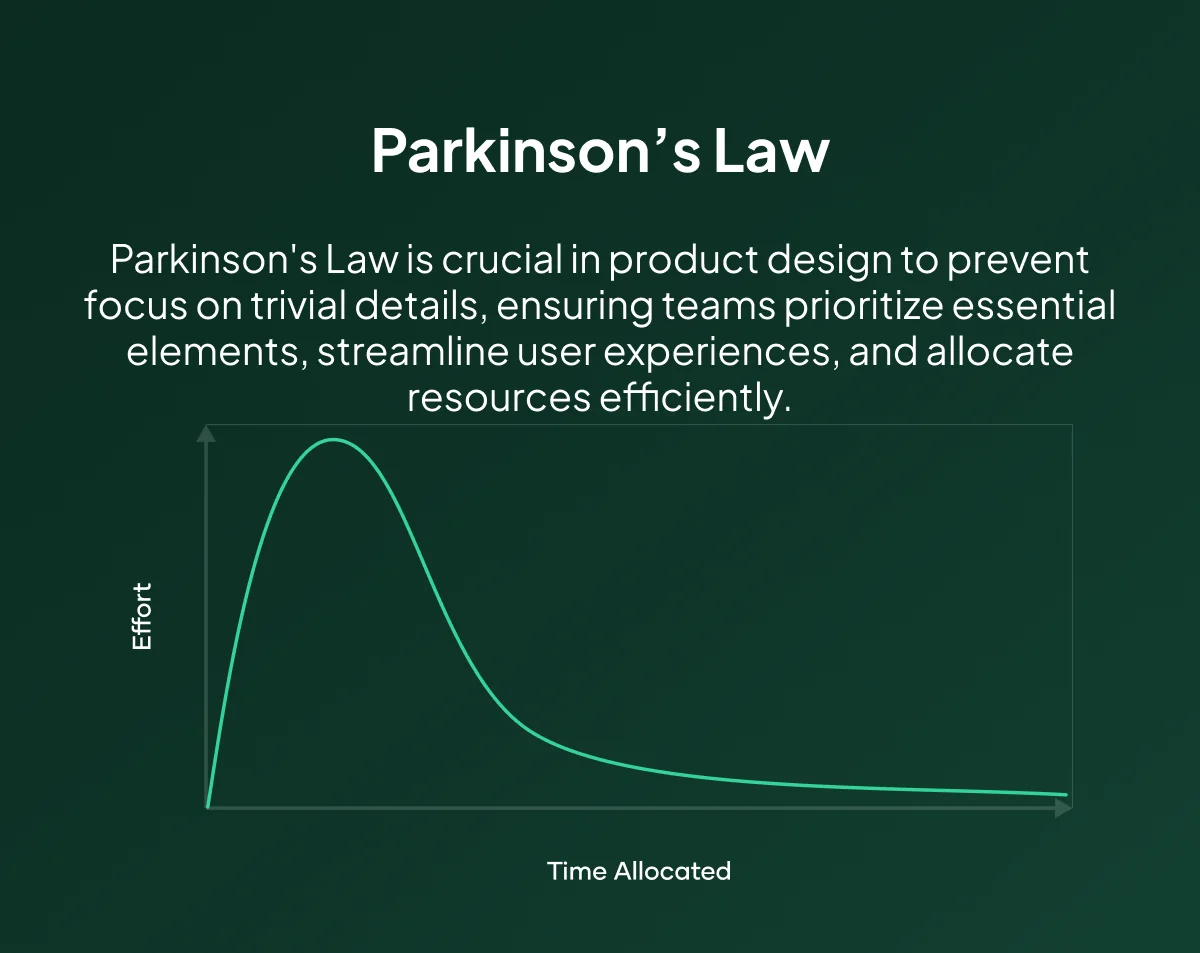
Parkinson’s Law —Tips
Extra Thoughts
Understanding Parkinson’s Law enables designers to navigate project complexities adeptly. Rather than succumbing to the allure of trivial details, teams can channel their efforts into addressing significant challenges, in the end expediting the design process and enhancing overall efficiency.
Takeaways
- Set Realistic Deadlines: Establishing time constraints compels teams to focus on what truly matters, avoiding unnecessary delays.
- Prioritize Core Functionality: Recognizing the Law’s essence, designers can prioritize critical aspects, ensuring a more impactful and user-centric design.
- Minimize Decision Fatigue: Streamlining choices prevents users from being overwhelmed, promoting a smoother and more efficient user experience.
- Transparent Task Duration: Communicating the estimated time required for tasks manages user expectations, fostering satisfaction and engagement.
- Continuous Optimization: Regularly analyzing data and iterating designs matters for ongoing improvement, aligning with the dynamic nature of user preferences.
Examples of Use
Samsung
Samsung uses Parkinson’s Law in user interface design, ensuring their smartphones provide an efficient and streamlined experience.

Parkinson’s Law Example — Samsung
Spotify
Parkinson’s Law is evident in Spotify’s approach to playlist creation. The platform optimizes the user experience by offering intuitive tools that facilitate swift playlist customization.
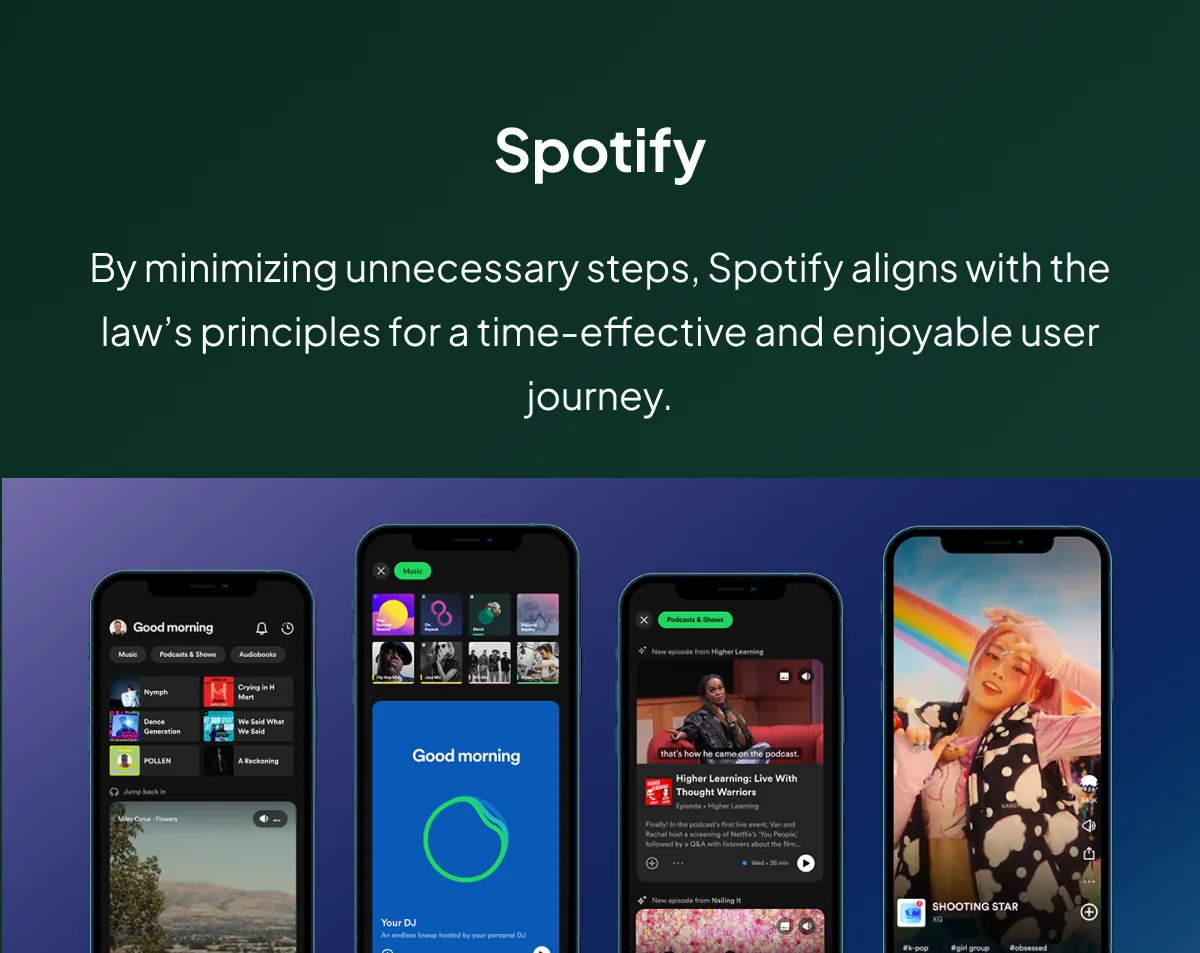
Parkinson’s Law Example — Spotify
Airbnb
In user experience, Airbnb focuses on simplifying the booking process. This aligns with Parkinson’s Law, promoting a hassle-free experience.

Parkinson’s Law Example — Airbnb
Uber
Uber applies Parkinson’s Law to its ride-hailing process, emphasizing a quick and straightforward user path.

Parkinson’s Law Example — Uber
Adobe Creative Cloud
Adobe Creative Cloud strategically incorporates Parkinson’s Law in its software interfaces. The platform prioritizes essential features, streamlining workflows for designers.

Parkinson’s Law Example — Adobe
Parkinson’s Law in Business and Marketing
In business and marketing, Parkinson’s Law serves as a guiding principle for efficient operations. By setting realistic project deadlines, teams can ensure timely execution and resource allocation. Focusing on essential tasks prevents teams from getting bogged down by trivial details, minimizing decision fatigue and fostering productivity.
Conclusion
Parkinson’s Law, deeply rooted in observing work dynamics, remains a guiding principle in enhancing user experiences across various industries. From the efficiency-driven design of Samsung smartphones to the smooth playlist creation on Spotify, renowned brands strategically use this Law to prioritize simplicity and user satisfaction.
User Experience Consultancy at Olively
As you navigate the complex landscape of product design and user experience, remember the essence of Parkinson’s Law. Prioritize essential elements, streamline interactions, and set realistic deadlines to optimize your efforts. Seek further guidance on implementing these principles into your design endeavors; the team at Olively stands ready to collaborate.I work with teams on decisions like this one.
Follow us here and on my personal LinkedIn page for ongoing insights and updates. Let’s continue the path of creating impactful and user-focused experiences together.
If you're weighing a decision like this on a live product, here's how I work with teams.
Part of the UX laws worth knowing — seventeen principles grouped by the decision each one helps you make.
Common questions
What is Parkinson's Law?
Work expands to fill the time available for its completion. Give a task a week and it takes a week; give it a day and it often still gets done.
How does Parkinson's Law apply to product design?
It argues for deliberately constrained timeboxes on design and build work, because an open-ended schedule invites scope to grow rather than the work to finish sooner.
How do you use Parkinson's Law without rushing the work?
The constraint should be on time, not on quality. Set a shorter window, cut the scope to fit it, and ship something complete rather than stretching an unbounded scope across an unbounded schedule.