Jakob's Law: Why Users Expect Your Product to Work Like the Others
When to follow convention, and when to break it.

In the changing landscape of digital interfaces, user experience (UX) stands as a critical battleground for businesses and designers alike. Coined by Jakob Nielsen, a renowned usability expert and principal of the Nielsen Norman Group, Jakob’s Law encapsulates a fundamental truth that has shaped digital products since its inception.
Understanding Jakob’s Law
At its core, Jakob’s Law articulates a simple yet powerful principle: users prefer new products or websites to function similarly to those they already know. Individuals are psychologically inclined to transfer their expectations from familiar products to novel ones. This phenomenon underscores the importance of familiarity and adherence to established design patterns in creating compelling user experiences.
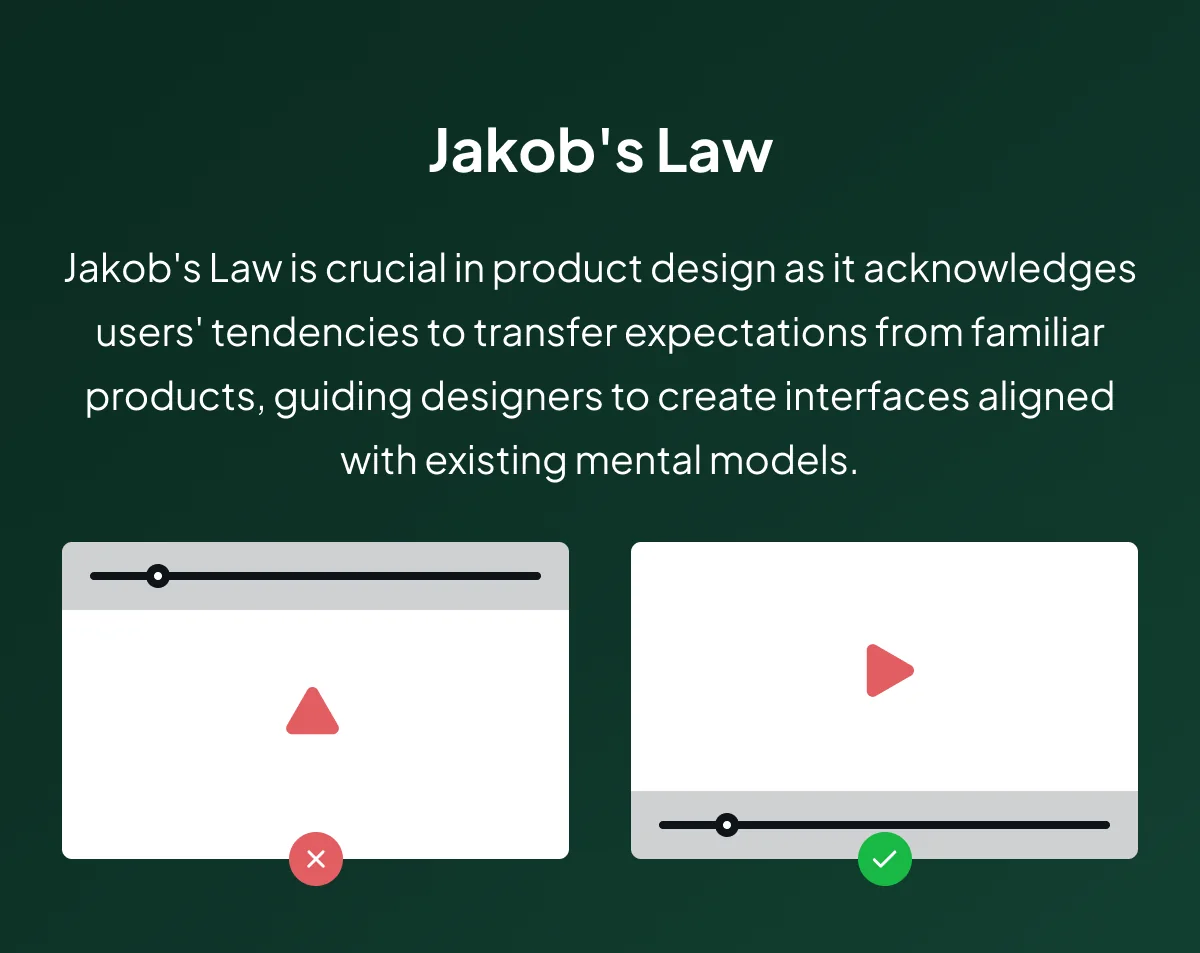
Jakob’s Law — Product Design Example
Why Jakob’s Law Matters in Product Design
The significance of Jakob’s Law in product design cannot be overstated. It acknowledges the inherent tendency of users to carry over expectations and mental models developed through previous interactions. By recognizing and using this tendency, designers can streamline the user learning curve, in the end enhancing usability.
Consider the scenario where users encounter a new website or application. The cognitive load is significantly reduced if the design aligns with patterns they’ve grown accustomed to. Users can navigate effortlessly, focusing on their tasks rather than grappling with a steep learning curve. This adherence to familiarity not only improves user satisfaction but also encourages continued engagement.

Things like form toggles, radio inputs, and even buttons originated from the design of their tactile counterparts. Source: Laws of UX
Key Takeaways
- User Expectation Transfer: Users naturally apply expectations from one familiar product to another.
- Using Mental Models: Designers can improve user experience by aligning with users’ established mental models, promoting ease of use.
- Minimizing Discord: When implementing changes, enabling users to stick with a familiar version temporarily minimizes disruption.
- Balancing Design Trends: While embracing design trends is essential, evaluating them for usability and aligning with Jakob’s Law ensures consistency.
- Consistency Over Trends: Design trends may evolve, but Jakob’s Law principles ensure the constancy of user-centric interfaces.

Jakob’s Law — Product Design Example
Working in the Design Landscape
In practical terms, Jakob’s Law prompts designers to balance innovation and user expectations. Design trends may come and go, but the principles encapsulated in Jakob’s Law provide a durable foundation for user-centric design.
Consider the YouTube redesign in 2017, a prime example of Jakob’s Law in action. Instead of imposing a radical change, users were allowed to transition to the new Material Design UI gradually. This approach minimized mental model discordance, enabling users to switch when ready. Google, too, has a history of allowing users to opt-in to redesigned versions, aligning with Jakob’s Law principles.

YouTube Redesign (2017) and Jakob’s Law
Jakob’s Law in Business and Marketing
Beyond design, Jakob’s Law extends its influence into business and marketing strategies. Aligning products or services with users’ familiar experiences ensures quicker adoption. Consistency in design fosters trust, leading to improved customer satisfaction and loyalty. The law guides the crafting of a brand image that resonates with users.
In Conclusion
Incorporating Jakob’s Law into UX design is not just a best practice; it’s an essential strategy for creating interfaces that resonate with users. By understanding users’ familiarity with existing interfaces, aligning with their mental models, and maintaining consistency, designers can create intuitive and user-centric experiences.
While design trends add visual appeal, they should be implemented thoughtfully, considering the impact on familiarity and usability. Prioritizing Jakob’s Law principles allows UX designers to build aesthetically pleasing and intuitive interfaces, improving user satisfaction and engagement.
Product Design Consultancy at Olively
Collaborate with Olively
Feel free to contact us at Olively if you need further guidance on implementing these principles into your design endeavors. At Olively, I work with teams on decisions like this one.
For more insights and updates, follow me here and on my personal LinkedIn page.
Let’s shape a user-centric future together!
If you're weighing a decision like this on a live product, here's how I work with teams.
Part of the UX laws worth knowing — seventeen principles grouped by the decision each one helps you make.
Lifting AI adoption without retraining the model — meeting people inside the tool they already lived in.
Common questions
What is Jakob's Law?
Users spend most of their time on other people's products, so they expect yours to work the same way. Familiar patterns carry expectations that your interface inherits whether you intended it or not.
Should you always follow existing conventions?
Follow them wherever the convention is not the thing you are competing on. Break one only where the departure is the point, and where the gain is larger than the cost of teaching someone a new pattern.
What happens when you ignore Jakob's Law?
People apply the mental model they already have, the interface does not respond as expected, and the resulting confusion reads as the product being difficult rather than different.