Miller's Law: Enhancing User Experience
What it says about memory, and what it is often misquoted as saying.

Definition of Miller’s Law
Miller’s Law posits that our cognitive capacity to absorb and recall information is limited. It’s not about the magical number seven per se, but rather the concept of “chunks.” These chunks represent meaningful units of information grouped together, whether they are words, images, or other data points.

An Example of Chunking — Miller’s Law
Additional Thoughts
While there isn’t a strict formula for Miller’s Law, the essence lies in recognizing the limits of working memory and designing accordingly. It’s not just about the number of chunks but also about their meaningfulness and relevance. Designers should consider the context, familiarity of users with the content, and the specific capacity of their target audience.
In essence, Miller’s Law nudges designers to think beyond arbitrary limits and focus on the art of chunking — creating meaningful, easily digestible clusters of information.
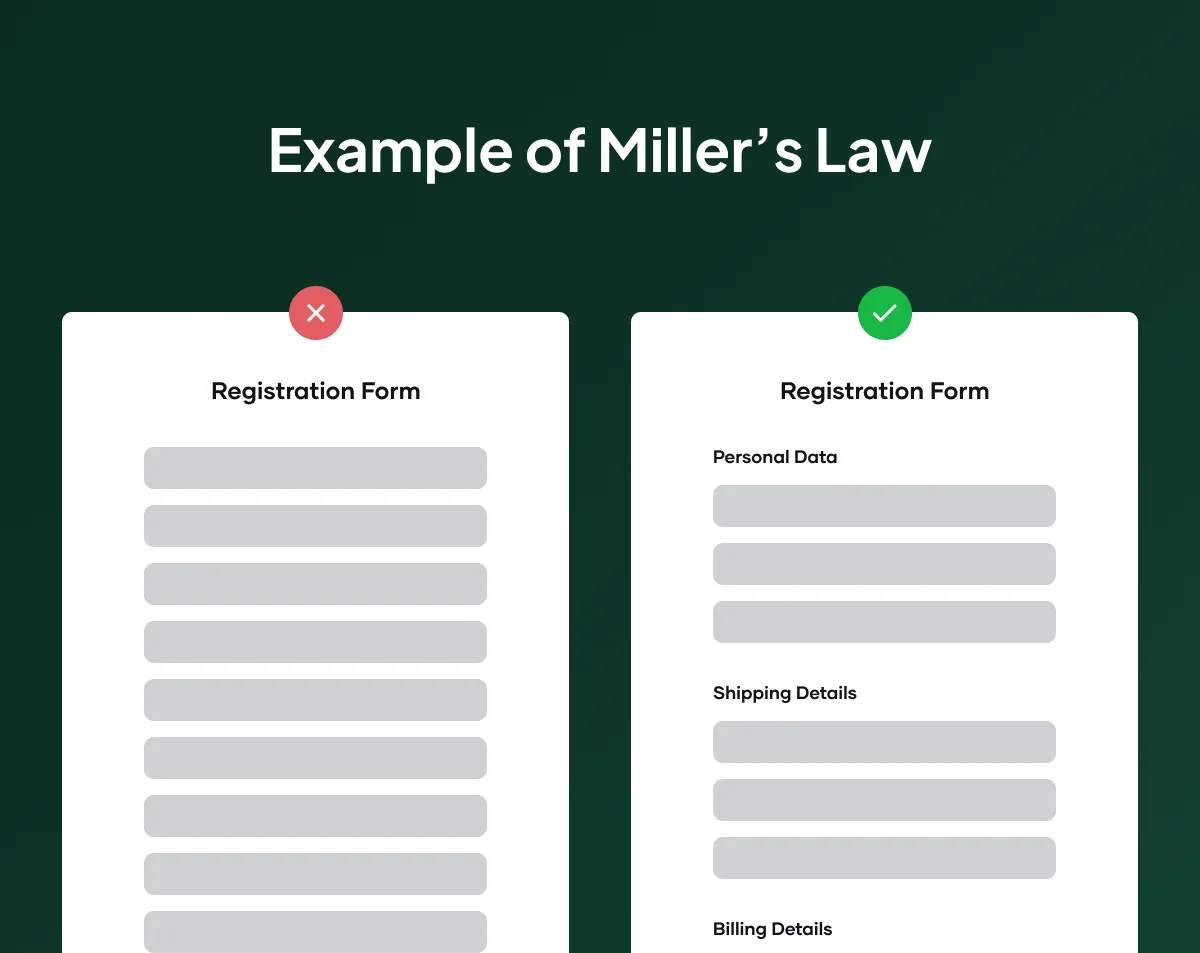
UI Example of Miller’s Law
Why is it Important in Product Design?
In product design, Miller’s Law is a guiding light. Recognizing and applying this principle changes how users interact with digital interfaces. Here’s why it’s indispensable:
- Optimizing Cognitive Load: By understanding working memory constraints, designers can strategically organize content into digestible chunks. This optimizes cognitive load, making it easier for users to process and retain information.
- Facilitating Information Retrieval: Products that align with Miller’s Law are more user-friendly. Whether it’s a website with well-organized navigation or a mobile app with a streamlined interface, adhering to this principle facilitates swift information retrieval.
- Reducing Decision Fatigue: Limiting the number of choices presented at a given time reduces decision fatigue. Users can make quicker and more informed decisions when options are presented in manageable chunks, aligning with the constraints of their working memory.
- Enhancing Learnability: When onboarding users, presenting information in smaller, meaningful chunks aids learning. Users can grasp concepts more easily, fostering a positive and efficient user experience.
- Designing for Varied Capacities: Recognizing that individuals may have different working memory capacities, Miller’s Law encourages designers to create interfaces that accommodate various users. This inclusivity is key to a successful and accessible product.
Examples in Action
Real-world examples vividly illustrate the application of Miller’s Law in product design:
1. Apple’s iOS App Icons
The home screen of an iPhone exemplifies chunking. A limited number of app icons are displayed, and users can further categorize these icons. This organized chunking of information lets Users quickly locate and interact with apps.

Apple’s iOS App Icons and Miller’s Law
2. Twitter Feeds
Twitter applies Miller’s Law by limiting the lengths of tweets and presenting them concisely. Users scroll through bite-sized chunks of information, enhancing the platform’s usability.

Twitter Feed and Miller’s Law
3. E-commerce Product Listings
Websites like Amazon strategically organize product information. Details such as product specifications, reviews, and pricing are chunked, simplifying the user’s decision-making process.
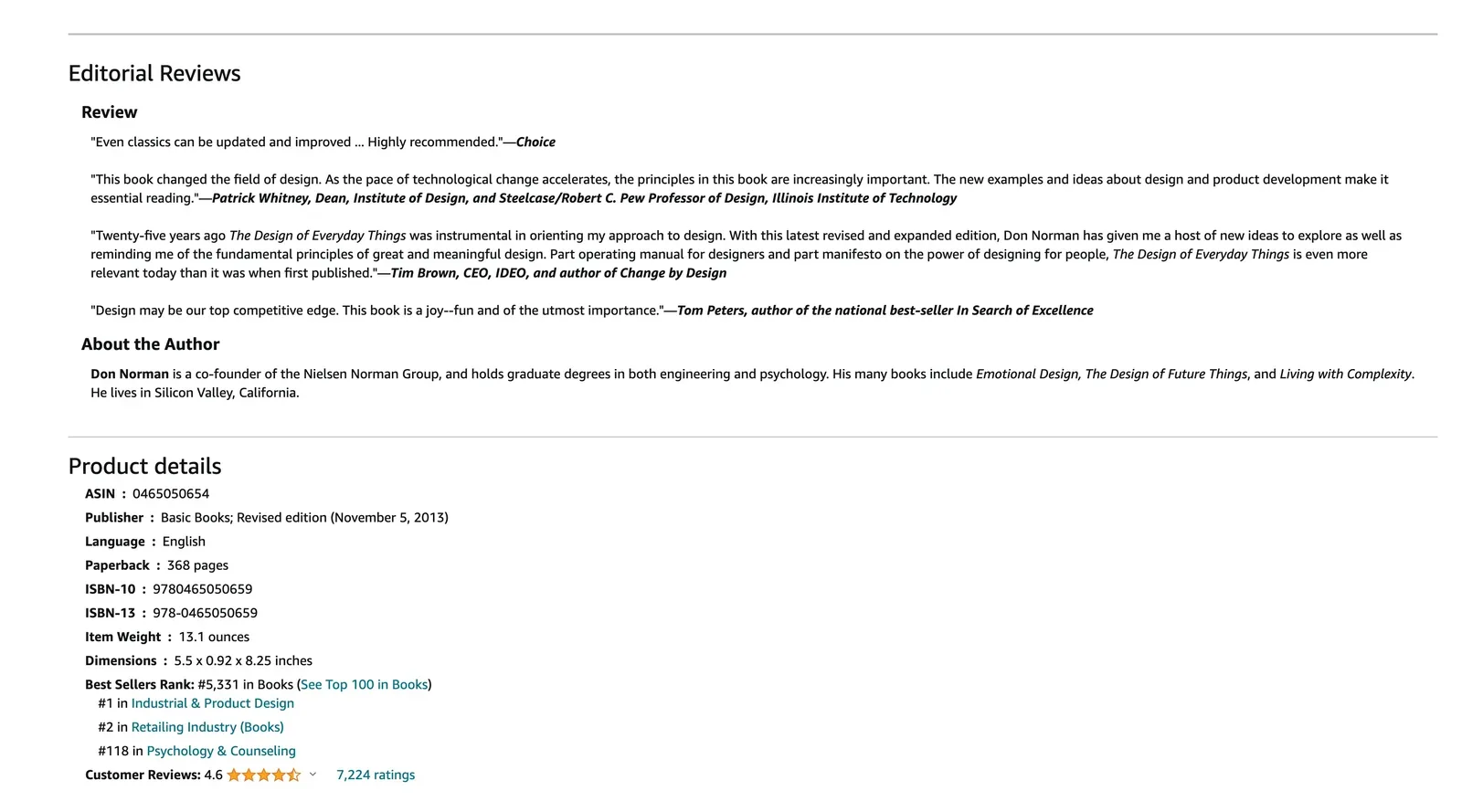
Amazon Product Specifications. Source: Amazon
Conclusion
In conclusion, Miller’s Law isn’t a rigid constraint but a guiding principle that enables designers to enhance user experience. By respecting the limitations of working memory, designers can create products that are not only visually appealing but also intuitively navigable, in the end improving the user’s path.
Feel free to reach out for tailored guidance on integrating Miller’s Law into your business and marketing strategies. At I work with teams on decisions like this one.
For deeper insights, stay connected here and on my Medium page.
If you're weighing a decision like this on a live product, here's how I work with teams.
Part of the UX laws worth knowing — seventeen principles grouped by the decision each one helps you make.
Common questions
What is Miller's Law?
The average person can hold about seven items, plus or minus two, in working memory at once. Beyond that, recall degrades quickly.
How does Miller's Law apply to interface design?
It argues for chunking — breaking information into small, meaningful groups rather than presenting a long undifferentiated list. A phone number is easier to remember in three chunks than as ten digits.
Does Miller's Law mean limiting menus to seven items?
Not literally. The limit applies to what someone must hold in mind, not to what is visible on screen. A menu they can read and re-read is not a memory task; a sequence they must recall from a previous step is.