Hick’s Law in Product Design
Every extra choice adds time to the decision.

Definition of Hick’s Law
Hick’s Law is a psychological principle that quantifies the relationship between the number of stimuli or choices presented to an individual and the time it takes for them to make a decision. The law is often expressed by the formula:
RT = a + b log (n)
where,
RT: Reaction Time
(n): Number of stimuli
a: Total decision-making time
b: Constant based on cognitive process time for each option.
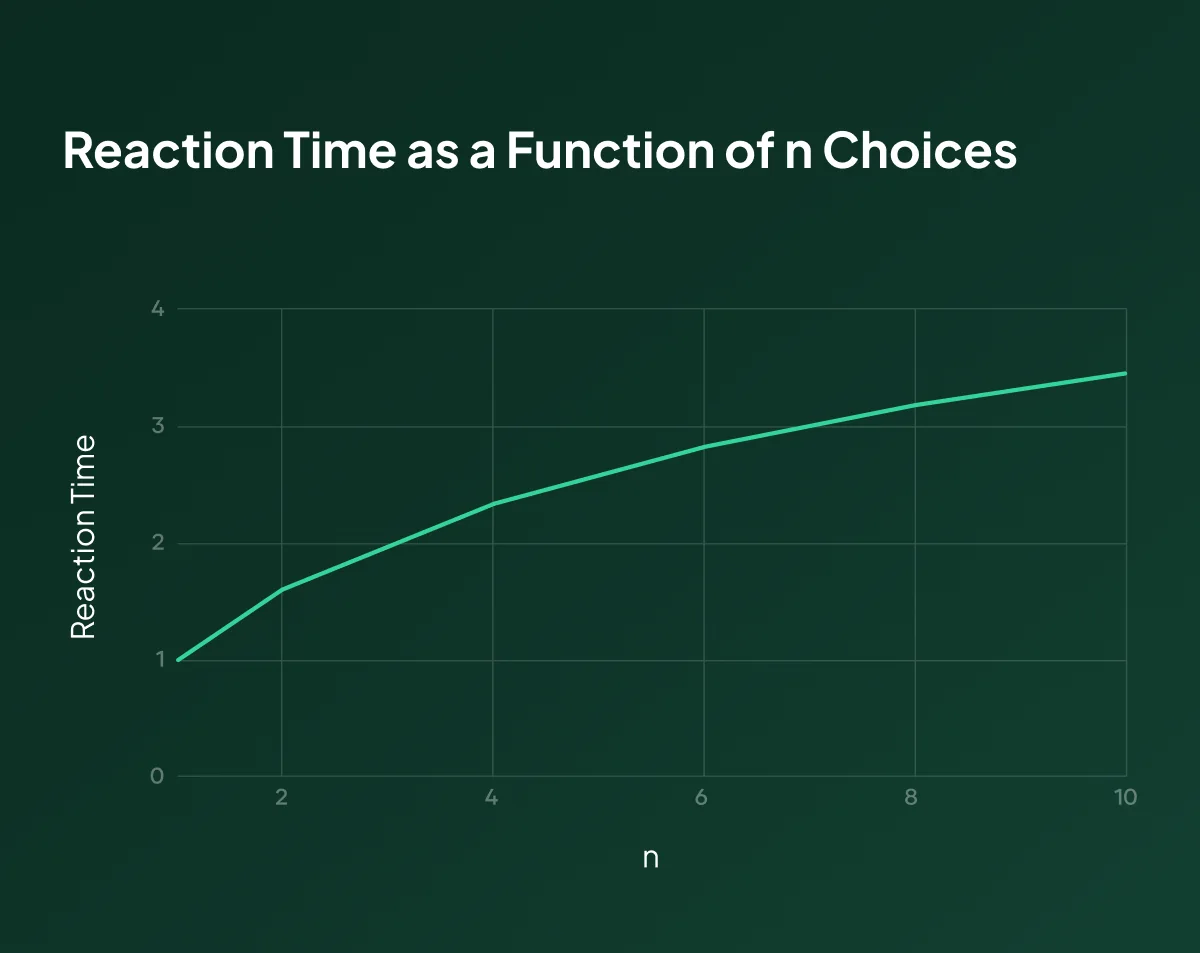
Reaction Time as a Function of n Choices
Additional Thoughts
The formula RT = a + b log2(n) encapsulates the essence of Hick’s Law. While it predominantly applies to scenarios involving simple, quick decisions, its principles can be adapted to various design contexts. Designers must recognize the delicate balance between offering choices and overwhelming users. The formula underscores that, beyond a certain point, an increase in choices yields diminishing returns in user satisfaction.

Users might feel overwhelmed if we present too many choices, and in the end, they might leave the situation/website to decrease cognitive overload.
Importance in Product Design
The application of Hick’s Law is pivotal in product design for several reasons. Firstly, it addresses decision fatigue — the mental exhaustion resulting from prolonged decision-making. By limiting choices, designers prevent users from feeling overwhelmed, ensuring a more streamlined and efficient decision-making process. Secondly, it aligns with the “Keep it Simple, Stupid” (KISS) principle, promoting clarity and user-friendly interfaces. This is particularly key in a world with limited attention spans, and users seek intuitive, straightforward experiences.

“Keep it Simple, Stupid” (KISS)
Takeaways
- Minimize Choices: Reduce the number of choices to decrease decision time.
- Break Complex Tasks: Divide intricate processes into smaller, manageable steps to alleviate the cognitive load.
- Highlight Recommendations: Guide users by emphasizing recommended options to streamline decision-making.
- Progressive Onboarding: Introduce features gradually to minimize cognitive load for new users.
- Balance Simplicity: Avoid oversimplification to the point of abstraction; maintain a balance between simplicity and functionality.
Real-world Examples
1. Amazon’s One-Click
Streamlined purchasing with a single click minimizes decision time.

Amazon’s One-Click. Source: Knowledge at Wharton Podcast
2. Netflix’s Autoplay
Continuously playing content reduces the need for users to decide what to watch next.

Netflix’s Autoplay
3. Instagram Stories’ Swipe-up
Simplified navigation with a swipe-up gesture for quick actions.

Instagram Stories’ Swipe-up. Source: Pinterest
4. Tesla’s Autopilot
Automated driving features simplify decision-making for the driver.

Tesla’s Autopilot
5. Apple AirPods’ Connectivity
Smooth pairing exemplifies effortless decision-making in product usage.
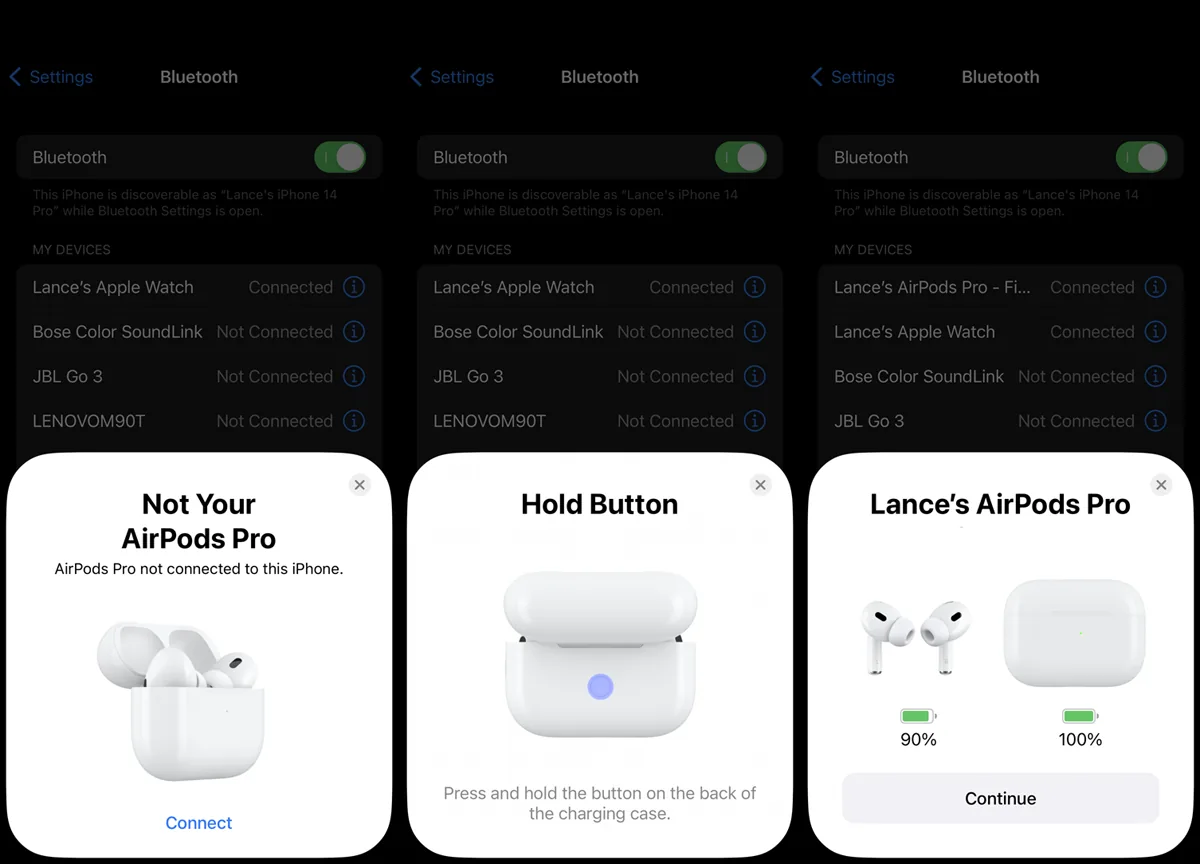
Apple AirPods’ Connectivity. Source: PCMag
Business and Marketing Contexts
In business and marketing, using Hick’s Law matters. Streamlining choices on websites or in product displays minimizes customer decision time, enhancing their experience and increasing the likelihood of conversions. Simplifying options aligns with consumer preferences for efficient decision-making, contributing to higher engagement and satisfaction.
Conclusion
Hick’s Law serves as a guiding principle for designers aiming to enhance user experience. Its strategic application not only reduces decision time but also contributes to creating products that are intuitive, efficient, and user-centric. Designers who master the art of simplifying choices in alignment with Hick’s Law are poised to deliver experiences that resonate with today’s discerning and time-conscious users.
For further guidance on integrating Hick’s Law into your design strategy, reach out to us.I work with teams on decisions like this one. Stay tuned for more insights — follow me here and on my LinkedIn for regular updates.
If you're weighing a decision like this on a live product, here's how I work with teams.
Part of the UX laws worth knowing — seventeen principles grouped by the decision each one helps you make.
Common questions
What is Hick's Law?
A psychological principle quantifying the relationship between the number of choices presented and the time taken to decide. The formula is RT = a + b log₂(n): decision time rises with the logarithm of the number of options.
How does Hick's Law apply to product design?
It addresses decision fatigue directly. Limiting choices at any single step reduces the mental cost of using the product, which is why complex tasks are broken into stages and why a recommended option is usually highlighted.
Does Hick's Law mean fewer features are always better?
No. It applies to choices presented at once, not to what a product can do. A large feature set surfaced gradually is easier to use than a small one shown all at the same time.