How to simplify digital products and increase value?
Cutting is harder than adding, and usually worth more.

As a business owner, working in the path to simplicity can lead to increased efficiency, enhanced customer experiences, and a more robust bottom line. Here’s a comprehensive guide on simplifying products and amplifying business value.
1. Embrace the Simplification Principle
At the heart of successful product simplification lies the application of the Simplification Principle. This principle, rooted in the levers of rationalization, standardization, and modularization, provides a roadmap to streamline processes, reduce operational costs, and enhance overall organizational efficiency.
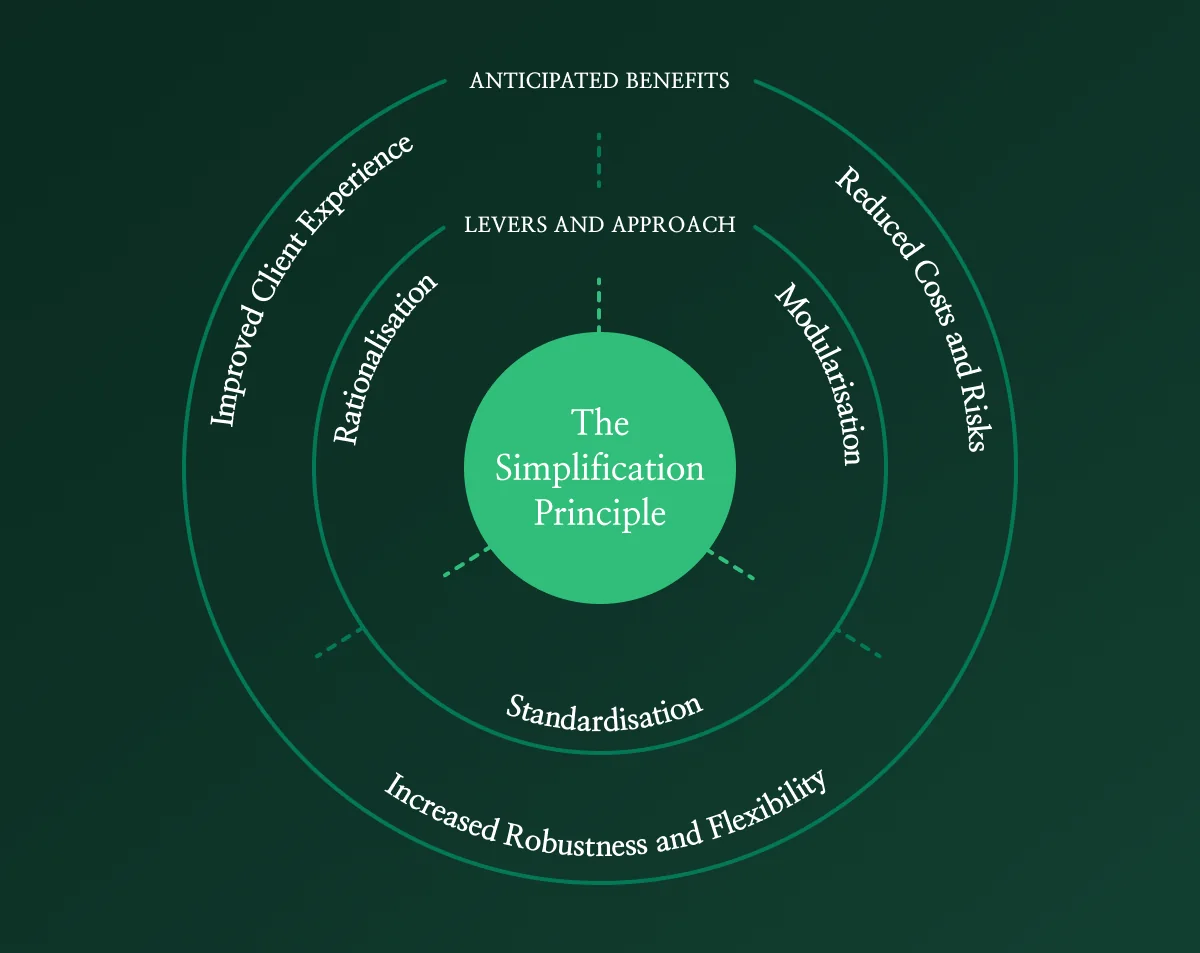
Simplification Approach. Original image: Toptal.com
2. Rationalization: Streamlining Complexity for Profit
Rationalization is about optimizing and reorganizing your business model. This could involve strategic changes in product and market strategies, organizational restructuring, or even scaling the size of your operation. A key rationalization aspect is discontinuation, which involves focusing on your core business strengths and shedding unnecessary complexities. For instance, streamlining complex product catalogs can significantly improve the bottom line by eliminating redundancies.
3. Standardization: Boost Efficiency through Uniformity
Implementing standardization involves using identical components across different platforms or products to improve overall efficiency. Whether it’s IT infrastructure or supply chain processes, standardization reduces costs and increases operational efficiency. For instance, car manufacturers benefit from building various models on the same chassis, showcasing the widespread applicability of this principle beyond manufacturing.
4. Modularization: Building Agility and Sustainability
Modularization allows organizations to reuse standardized building blocks efficiently, creating a flexible and agile system. Breaking down complex structures into modular components enables the swift development of new products, systems, and processes. Embracing a modular approach enhances efficiency and contributes to sustainability by promoting reusability, a key aspect in today’s circular economy.
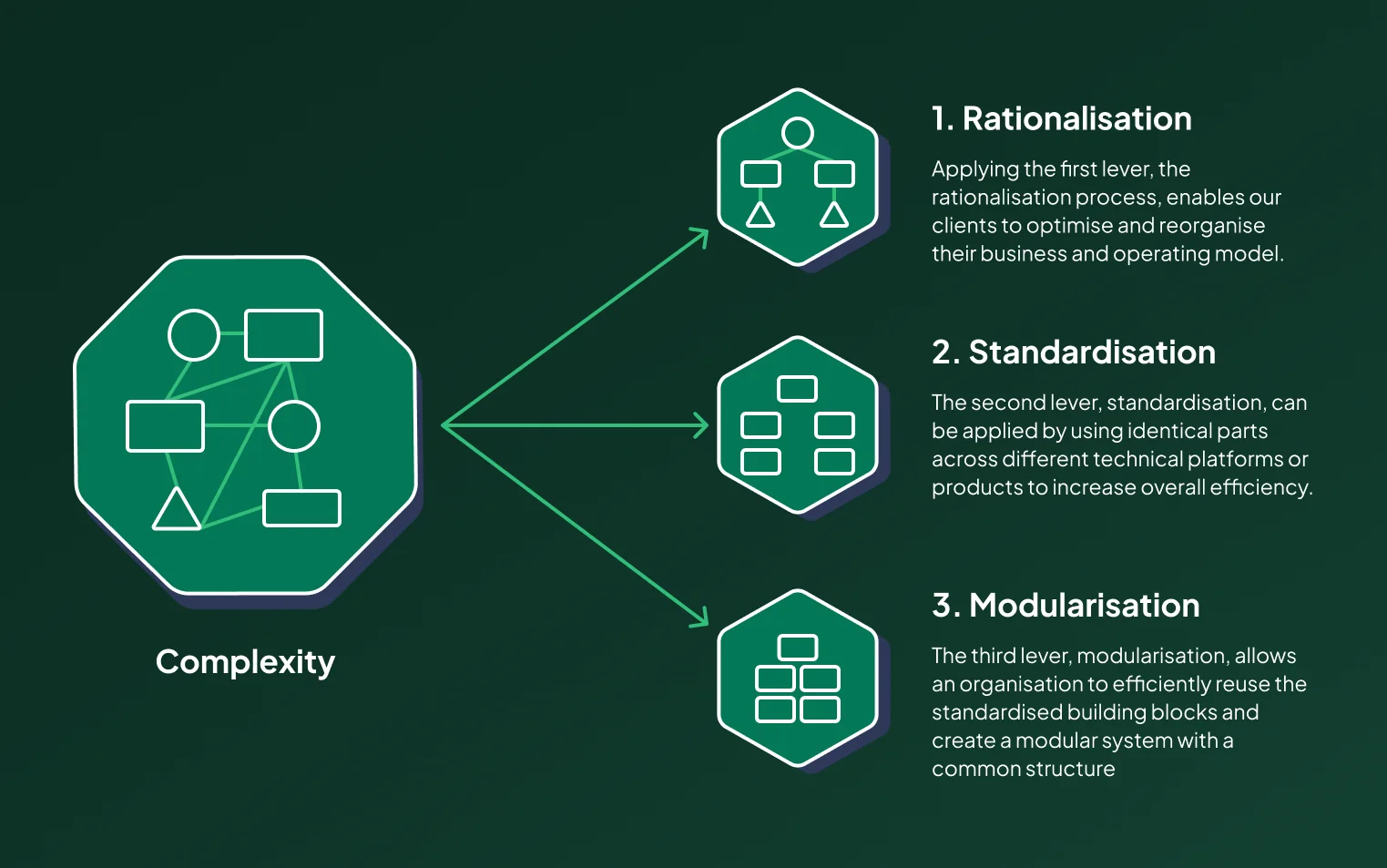
Overview of Simplification Levers. Original image: Toptal.com
5. Key Areas in Detail
Explore specific areas where the Simplification Principle can be applied, such as payments, cloud services, and legal entity structures. For instance, in payment simplification, rationalization can involve reorganizing the payment system, standardization can streamline processes, and modularization can create a flexible and efficient payment architecture.
6. Anticipated Benefits and Limitations
Understand the potential benefits of simplification, such as improved customer experience, cost reduction, and increased strategic flexibility. However, acknowledge the limitations, such as the impact on local cultures, the challenge of personalized products, and the influence of country-specific legal and regulatory requirements.
7. Implementation Approaches
Depending on your business’s current state, choose an approach that aligns with your goals. For businesses as usual (BAU), continually test decisions against simplification levers. In times of transformation, embed the simplification principle in every change initiative. Consider dedicated simplification initiatives with a four-step approach: Blueprint, Identify, Resolve, and Optimize.
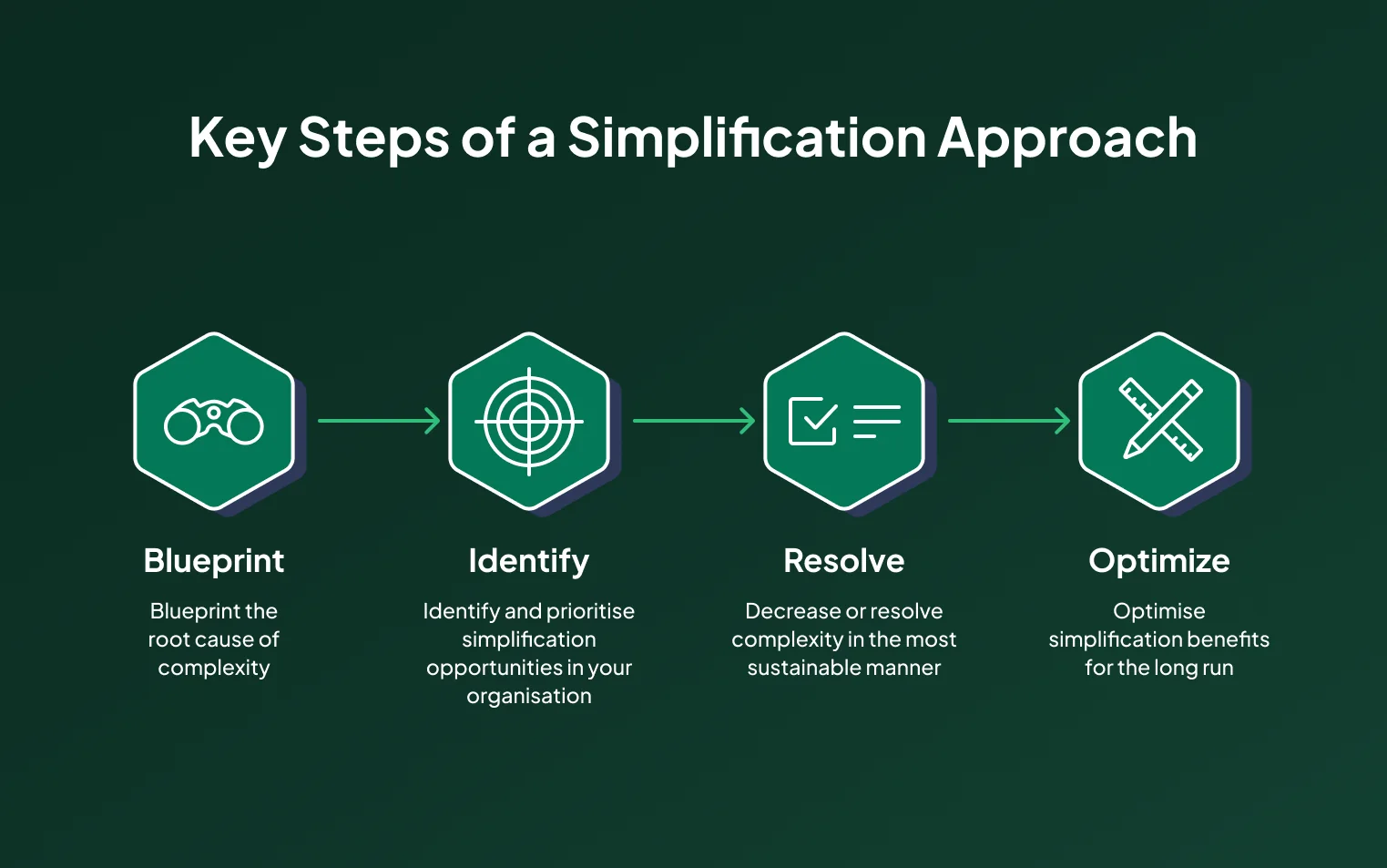
Key Steps of a Simplification Approach. Original image: Toptal.com
8. Legal Entity Simplification: A Pragmatic View
Explore the rationale behind maintaining a complex legal entity structure and the potential pitfalls. Work through the implications on employees, governance, systems, costs, and capital, and understand when and why rationalizing legal entities becomes imperative.
9. Recommendations for Business Owners
Large transformation projects often encounter challenges. Learn from observations demonstrating the importance of realistic scoping, focused business cases, and a complete approach to simplify without spiraling out of control.
Conclusion
In your path to simplify products and amplify business value, Olively is a strategic partner ready to guide you through each step. I work with teams on decisions like this one.
Product Design Consultancy at Olively
Feel free to contact us for personalized guidance tailored to your specific needs. At Olively, pursuing simplicity is not just a business strategy but a transformative path toward sustained success.
Stay connected for more insights and updates by following me here and on my personal LinkedIn page. Your success is our priority, and we look forward to catalyzing your path to business excellence.
If you're weighing a decision like this on a live product, here's how I work with teams.
Cutting enterprise change requests 15 to 7 minutes — cutting scope in half as the thing that made the numbers move.
Common questions
How do you simplify a digital product without losing value?
Through three levers: rationalisation, which reorganises the product and market strategy; standardisation, which reuses identical components across platforms; and modularisation, which makes parts interchangeable rather than bespoke.
What is the difference between simplification and cutting features?
Cutting removes capability. Simplification removes variation — the same outcome delivered through fewer distinct parts, so the product does as much with less to maintain and less to learn.
Where should product simplification start?
With the places variation has accumulated without a reason: near-identical components, parallel flows doing the same job, options nobody selects. Those cost maintenance and cognitive load and return nothing.