How to Build an AI MVP
Scope it around one measurable outcome, or it joins the 95%.
An AI MVP allows businesses to test their ideas, gather valuable insights, and validate the feasibility of implementing generative AI solutions. In this comprehensive guide, we’ll walk you through the essential steps to build a successful AI MVP tailored for business owners seeking to capitalize on this transformative technology.
Introduction
Before getting into the detail of building an AI MVP, it’s key to understand its significance. An MVP is the initial version of a product with the minimum features required to satisfy early adopters. Regarding AI, this approach enables startups to validate their AI-driven concepts without investing excessive time and resources upfront.
Defining Clear Business Objectives
The foundation of any successful AI MVP lies in clearly defined business objectives. Before looking at technicalities, identify specific goals your AI solution aims to achieve. Whether it’s optimizing internal processes, enhancing customer experience, or streamlining decision-making, articulate these objectives to guide your MVP development.
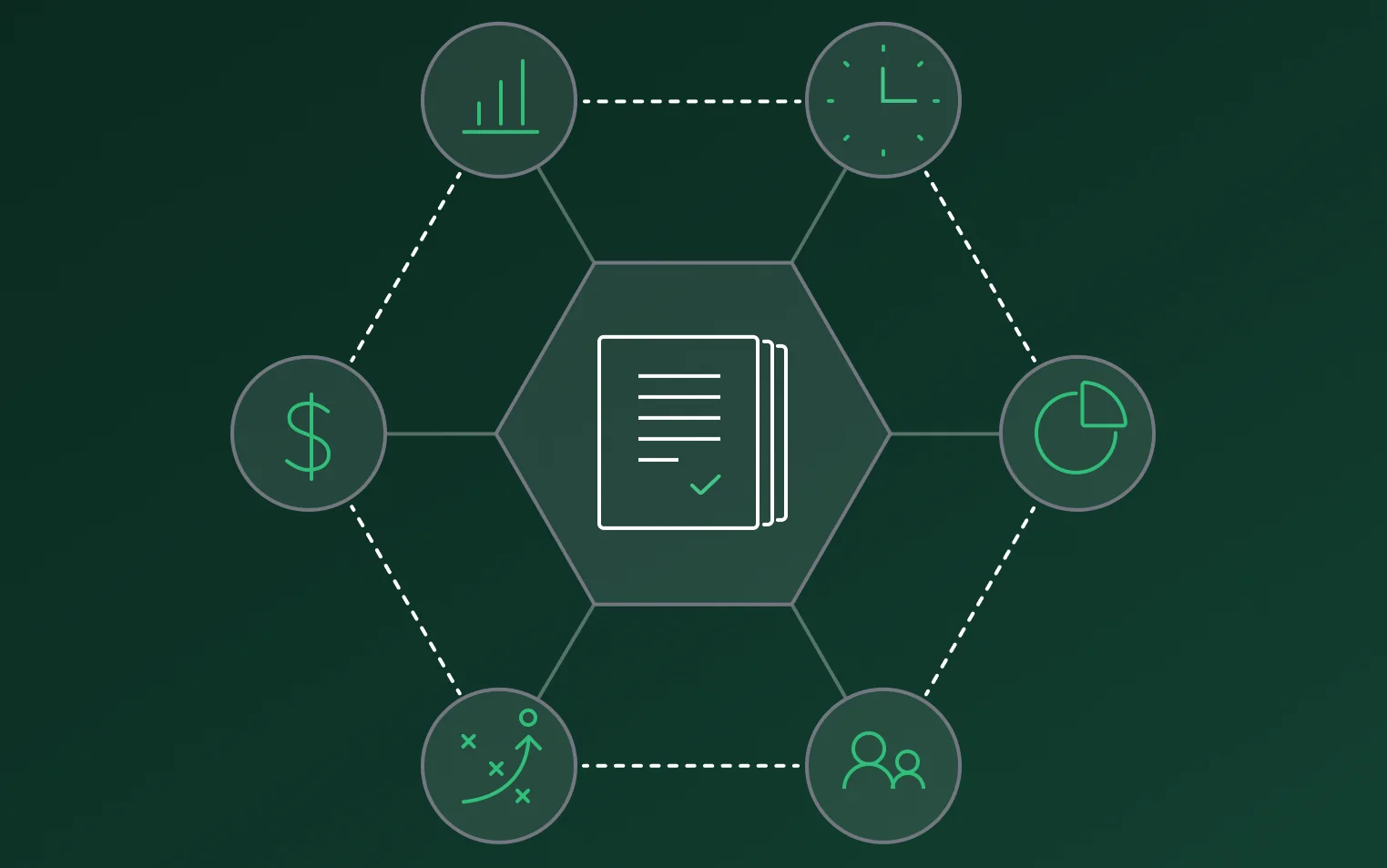
Defining Clear Business Objectives. Original image: Toptal.com
Identifying and Evaluating Use Cases
Not all AI applications are equal, and choosing the proper use cases is pivotal. Typical application areas include marketing, sales, product development, and customer support. Evaluate potential use cases against your business goals, considering factors like ease of implementation, integration with existing systems, and ethical considerations.
Project Discovery & Planning
With use cases identified, initiate a thorough project discovery and planning phase. Define the technical problem your AI MVP will address, select appropriate AI models, identify the technology stack, and outline the architecture of your solution. This stage sets the roadmap for subsequent phases, ensuring alignment with business goals.
Proof of Concept (PoC)
A PoC is a small-scale experiment to validate the technical viability of your AI MVP. While some argue it extends the project timeline, a well-executed PoC minimizes risks and provides valuable insights. Include tasks like data collection, model testing, and stakeholder feedback, allowing you to make informed decisions about continuing, iterating, or discontinuing the project.
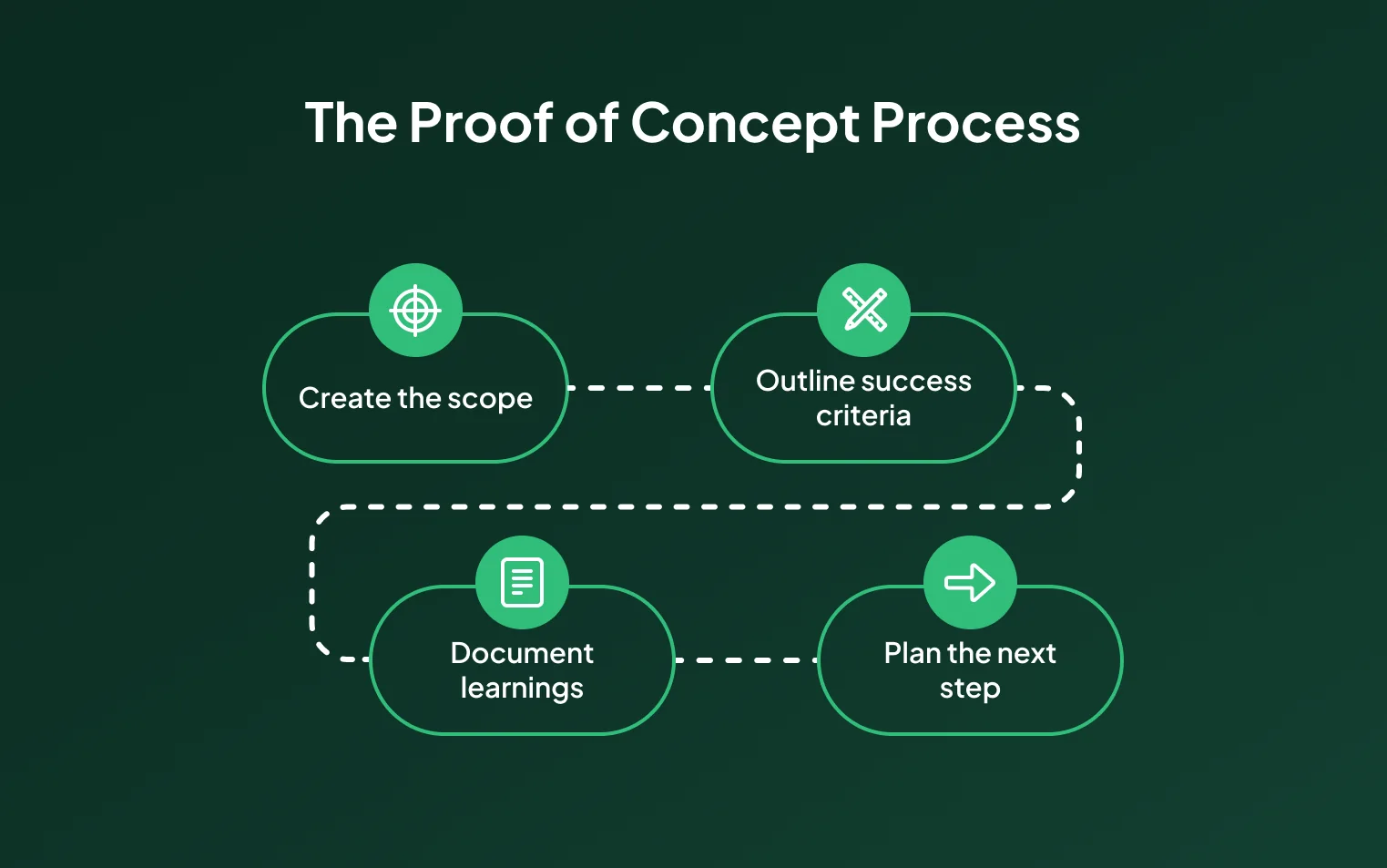
Proof of Concept (PoC) Process. Original image: Toptal.com
Pilot / MVP Implementation
Confident in your AI concept after a successful PoC? Move on to the Pilot/MVP implementation phase. Focus on refining the model, expanding data collection, UI development, integrating existing systems, and compliance with industry regulations. This stage aims to deliver a functional version of your AI product.
Full Implementation
With a validated MVP and positive user feedback, transition to full implementation. Scale up your generative AI solution to accommodate larger datasets, add new features, integrate with more departments, and enhance security measures. This phase marks transforming from a prototype to a fully operational AI solution.
Optimization and Maintenance
Generative AI projects are dynamic and require continuous monitoring. Regularly track model performance, address evolving dynamics, and optimize your solution for sustained value. While maintenance is less time-consuming than earlier stages, proactive monitoring ensures ongoing success.

Optimization and Maintenance. Original image: Toptal.com
Importance of User Experience and Product Design
In AI, user experience (UX) and product design are pivotal. A smooth interface enhances adoption and ensures your AI solution aligns with user needs. Finding an experienced product designer is indispensable for creating intuitive interfaces and optimizing user interactions.
Hire Me for Your AI MVP Path
For a successful AI MVP, consider the expertise of a seasoned product and UX designer. I specialize in crafting engaging, user-centric designs for AI products. Explore my Work page to witness the impact of design on AI solutions. Your path to a transformative AI MVP begins with the right design — contact me for a free consultation on Generative AI implementation.
Conclusion: Your Path to AI Success
Embarking on the path to build an AI MVP is an exciting venture for any business owner seeking innovation and growth. As you navigate the complexities of generative AI implementation, remember that success is not just about the technology — it’s about user experience and intuitive design.
Product Design Consultancy for Startups at Olively
Feel free to reach out if you need further guidance on any aspect of your AI MVP path. I work with teams on decisions like this one.
Stay updated with the latest insights and industry updates by following me here and on my personal LinkedIn page. Your success story in AI awaits — let’s build the future together!
Before you build: is it actually an AI problem?
The cheapest AI MVP is the one you don't build. In a forty-use-case assessment inside a regulated European enterprise, several proposals turned out not to be AI at all — they were rules engines, lookup tables or reporting jobs with a model bolted on for the pitch. Each would have worked better, faster and cheaper as the thing it already was.
Before scoping, answer three questions honestly:
- Does the output need to be probabilistic? If the same input should always produce the same output, you want logic, not a model.
- Do you have the data, and can you use it? Not "does it exist somewhere" — can you legally, practically get it into a training or retrieval pipeline this quarter.
- What breaks if the answer is wrong 5% of the time? If the answer is "a lot", you're building a review workflow, not just a model.
Scope it around one number
MIT's Project NANDA found roughly 95% of enterprise AI pilots produce no measurable effect on profit and loss. The pattern behind that is consistent: nobody agreed what success looked like before the work started, so the pilot could neither succeed nor be killed.
Fix that before writing code. Name the number the MVP is supposed to move, write down where it stands today, and state what "worth continuing" looks like. If the number doesn't exist yet, that's your first finding — and it's worth knowing in week one rather than after a quarter of engineering.
Set kill criteria before you start
Write down, in advance, the result that would make you stop. Teams that skip this end up in what Gartner calls pilot purgatory: the demo worked, nobody can prove the thing is worth scaling, and nobody is willing to be the person who kills it. A stated threshold turns that from a political decision into an arithmetic one.
If you're weighing a decision like this on a live product, here's the AI Reality Check.
More on this: which use cases are worth building.
Cutting enterprise change requests 15 to 7 minutes — scoping an AI feature down to one measurable outcome — 15 minutes to 7, and compliance from 72% to 89%.
Common questions
What is an AI MVP?
The smallest version of an AI-powered product that proves the model actually helps with the task, rather than proving the model runs. The test is whether the output changes a decision, not whether it generates something.
What should you scope into a first AI release?
One workflow, one measurable outcome, and a way to tell whether the AI part is responsible for the change. Everything else waits until that question is answered.
What usually goes wrong with a first AI build?
Scoping around the technology rather than the decision it is meant to improve. If a rule or a database query would do the job better, the project is automation with an AI label on it.