Building Digital Products in a Recession
What still gets funded when budgets shrink.
To navigate through these difficult times, companies can turn to digital innovation and design thinking principles, learning from historical trends and using creative problem-solving.
Lessons from Previous Recessions
Historical data reveals that companies embracing innovation during economic downturns often emerge stronger and more resilient. Amidst the financial crisis of 2008–2009, organizations that continued or increased their investment in innovation achieved three times more growth than their counterparts over the subsequent three to five years. The ability to adapt and innovate has consistently proven to be a key differentiator during challenging economic climates.

Business Lessons from Previous Recessions
The current recession, exacerbated by the pandemic and global supply chain disruptions, presents a unique set of challenges. However, history suggests that disruptive periods can also be fertile ground for innovation. The sharing economy, the rise of e-commerce following the SARS epidemic in 2002, and the growth of sustainable technologies in response to climate change are all examples of industries that thrived in the wake of crises.
Design Thinking: Transforming Challenges into Innovation
Design thinking is a human-centered problem-solving framework applicable across various fields, including product design, IT, and business. Coined by Tim Brown, it blends people’s needs, technological feasibility, and viable business strategies to create customer value and market opportunities. This iterative process fosters creativity and collaboration, allowing non-designers to approach challenges with innovative solutions.
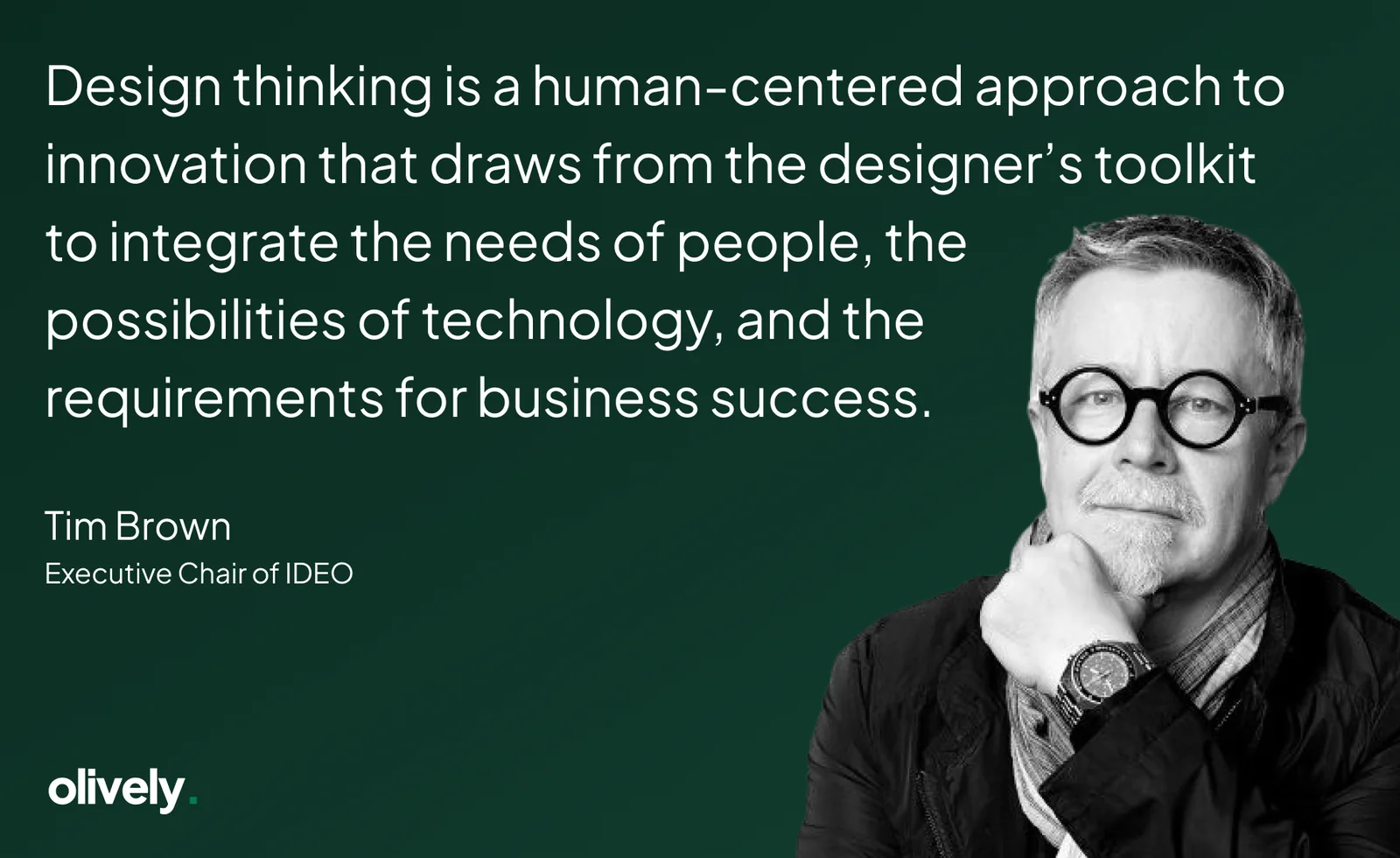
Tim Brown from IDEO on Design Thinking
Phases of Design Thinking:
- Understand: Get to the bottom of the problem, ensuring a comprehensive understanding before generating ideas. In the business context, understanding implies getting to the bottom of a problem. It necessitates a real grasp of the current problem, surpassing familiarity with past issues even if they resemble the current one. Business Example: A tech company aiming to improve software performance understands the challenge by researching current issues extensively, ensuring a nuanced understanding before proposing solutions.
- Observe: Empathize with those affected by the problem, gather information, and unveil needs and behaviors in the given context. Business Example: In healthcare, observing patient interactions provides valuable insights. Understanding their needs and concerns matters to designing more empathetic and effective healthcare solutions.
- Define: Analyze discoveries from previous phases, synthesizing them into a clear problem statement. Business-wise, this phase defines the challenge precisely, articulating why it demands attention and resolution within the business context.
Business Example: For a retail business, defining the challenge involves analyzing customer feedback to pinpoint specific issues. This leads to formulating a targeted problem statement for focused problem-solving.
- Ideate: Unleash creative powers to develop unexpected solutions based on patterns and findings from previous phases.
Business Example: In marketing, ideation may revolve around brainstorming unique approaches to campaign strategies, fostering creativity and innovation.
- Prototype: Select the best 2–3 ideas and make them tangible, providing depth and clarity to the proposed solutions. This phase transforms selected ideas into tangible representations in the business context, allowing teams to visualize and refine concepts before full-scale implementation.
Business Example: In the automotive industry, prototyping involves creating physical or digital models to test and refine design concepts before mass production, ensuring the viability and effectiveness of the proposed solutions.
- Test: Evaluate solutions with potential users, saving time and money by collecting feedback. Testing ensures that proposed solutions align with users’ needs, in the end saving resources compared to developing solutions without user input.
Business Example: Testing a new software feature in a tech company involves gathering user feedback and ensuring the solution meets user expectations and functions effectively in real-world scenarios.
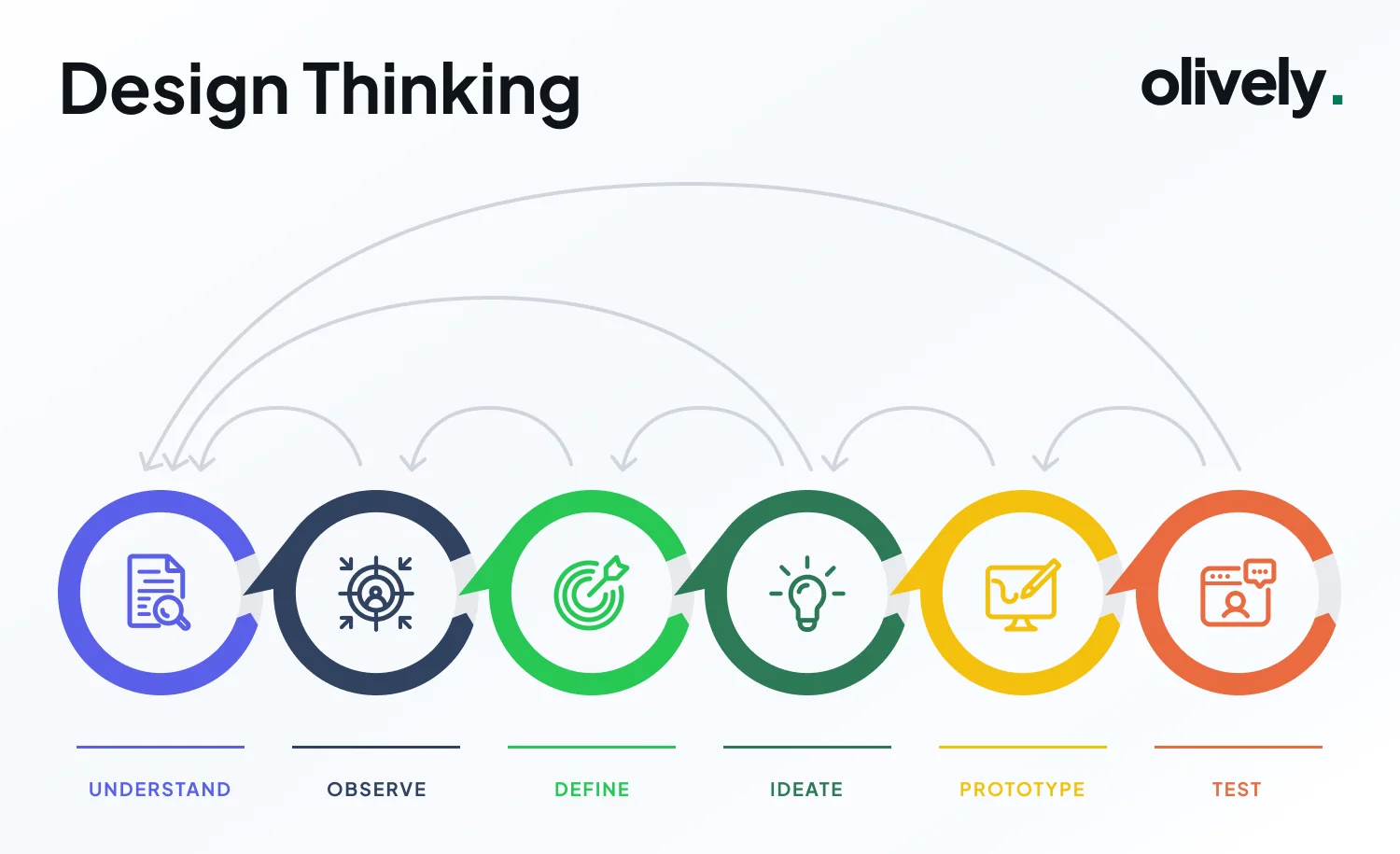
Design Thinking framework applied in the generic and business contexts
The Role of Design Thinking in Innovation
Design thinking offers a fresh perspective for companies seeking to weather the storm of a recession. McKinsey research demonstrates that companies embracing the business value of design outperform their peers, with Total Shareholder Returns (TSR) 56 percentage points higher from 2013 to 2018. Design can improve performance and resilience when integrated into an organization’s strategy.

companies embracing the business value of design outperform their peers
Prioritizing Innovation with Design Thinking
One of the immediate challenges for companies during a recession is determining where to allocate resources. Traditional approaches involve substantial budget cuts across the board, including in product design and development. However, design thinking provides alternative solutions:
- Preserving Cash Flow: Rather than pausing all innovation initiatives, companies can use design research to prioritize one or two products based on user preferences and business impact. Simultaneously, resources freed by pausing other products can be allocated to user-centric digital marketing, providing a cost-effective way to connect with consumers.
- Better Scenario Planning: Recessionary periods' uncertain and volatile nature demands a strategic response. Design thinking, emphasizing user-centric insights, complements analytical scenario planning. By integrating design, organizations can explore broader possibilities and develop more adaptable strategies to unexpected challenges.
- Managing Supply Chain Risk: Supply chain disruptions are a common threat during a recession. Rather than solely seeking alternative suppliers, design thinking recommends redesigning products based on user needs. By validating a wider range of parts or eliminating unnecessary components, companies can create more resilient products, reduce costs, and limit delivery problems.
- Embracing Sustainability with “Skinny Design”: Despite economic pressures, design thinking encourages companies to see sustainability challenges as opportunities. “Skinny design,” a concept that reassesses products and packaging, enables companies to reduce costs, transport costs, and carbon footprint simultaneously. Redesigned products can lead to innovative solutions, such as moving from liquid to powder form, reducing packaging size, and minimizing environmental impact.
- Internal Efficiency through Design: Beyond external processes, design thinking can streamline internal operations. By applying a user-centric, collaborative approach to internal processes, companies can discover unmet needs, increase engagement across the workforce, and boost productivity while reducing general and administrative costs.
Conclusion
In conclusion, the current recession underscores the importance of prioritizing innovation and embracing design thinking. Companies that strategically allocate resources, integrate design into their scenario planning, manage supply chain risk, prioritize sustainability, and enhance internal efficiency will be better positioned to weather the current economic storm and thrive in the post-recession landscape. By learning from the past and using design thinking principles, organizations can navigate through difficult times and emerge as stronger, more innovative entities poised for future success.
Embracing design thinking can revolutionize your approach to problem-solving and innovation. I work with teams on decisions like this one. Should you require additional insights or assistance in integrating these principles into your business strategies, Olively stands ready to collaborate.
The AI line in a tightened budget
AI is the one budget line that has kept growing while others were cut, and it is now the one facing the sharpest questions. Boards that approved exploratory spending two years ago are asking what came back.
The honest answer for most organisations is: not much yet. MIT's Project NANDA found roughly 95% of enterprise AI pilots produce no measurable effect on profit and loss. That isn't an argument against AI spending. It's an argument against unmeasured AI spending, which in a downturn is the first thing to get cut — often along with the work that was actually paying back, because nobody could tell them apart.
If the budget is tight, three things protect the work worth keeping:
- A baseline per initiative. The number it's meant to move, and where that number stands now. Anything without one is indefensible in a budget review, regardless of merit.
- Fewer, larger bets. Six unfinished pilots consume more attention than two funded properly, and none of them reach production.
- Written kill criteria. Deciding in advance what result would stop the work turns cancellation into arithmetic rather than a loss of face — which is what usually keeps dead projects alive.
In a downturn the scarce resource isn't money, it's the credibility you spend asking for the next round of it. Measured work protects that. Unmeasured work spends it.
If you're weighing a decision like this on a live product, here's how I work with teams.
Turning a per-client survey into one framework — a request turned into a product, so the next version cost less than the last.
Common questions
Should you keep building products during a downturn?
Historical data shows companies that keep innovating through downturns tend to emerge stronger. The constraint changes what you build and how fast, not whether you build.
What is design thinking and how does it help in a recession?
A human-centred problem-solving framework running through understand, define, ideate, prototype and test. In a downturn its value is that it forces validation before spend, which is when getting the problem wrong is most expensive.
How do you decide what to build when budgets tighten?
By narrowing to problems that are demonstrably costing money now, and validating them before committing engineering. The discipline that matters is refusing to build on an assumption.