Mission-Driven Business: Integrating Strategy, Purpose, and Design Principles
A mission is only useful if it changes a decision.

Harnessing Missionary Power: Jeff Bezos on Business Transformation
In his insightful statement, Jeff Bezos emphasizes the transformative power of a missionary approach in business. He contends that missionaries, driven by a deeper purpose beyond mere profit, create superior products. This perspective aligns with the idea that a well-defined mission and purpose propel businesses toward success. The integration of business strategy, goals, and product design under the umbrella of a compelling mission fosters a unique and impactful approach to the market.
Business Strategy and Mission
A robust business strategy is like a roadmap that guides the trajectory of an organization. However, as Bezos suggests, a missionary mindset improves this strategy beyond mere profitability. A mission-driven company not only aims for financial success but also seeks to make a meaningful impact. Aligning business goals with a higher purpose gives employees a sense of shared mission, fostering a culture that goes beyond profit margins.
Defining Mission and Principles
To understand the role of mission, it matters to distinguish between principles and values, as outlined by Stephen R. Covey. Principles, in this context, are the durable, objective rules that guide behavior and decisions. On the other hand, values are subjective beliefs that may change over time. Applying this distinction to business, defining a clear mission serves as a set of principles, akin to natural laws. This mission transcends individual and cultural differences, providing a guiding compass for decision-making.

Image of Stephen R. Covey's book, The 7 Habits of Highly Effective People. Source: LinkedIn, Sam Beardall.
Mission Statement and Purpose
A mission statement serves as a concise summary of an organization's purpose, priorities, and daily activities to achieve its goals. Crafting a meaningful mission statement involves reflection on core values and principles, aligning the organization with a higher purpose. Whether for corporations or individuals, a mission statement is not a mere formality; it is a compass steering actions toward a greater good.
Simon Sinek's Golden Circle Framework
Simon Sinek's Golden Circle framework reinforces the importance of a company's beliefs and purpose as the core of its existence. The "Why," representing the organization's purpose or belief, transcends mere products or services. This concept underscores that people connect with the why, not just the what. Integrating this framework into business practices provides a sense of purpose and motivation for employees, shaping product features, value proposition, and marketing strategies.
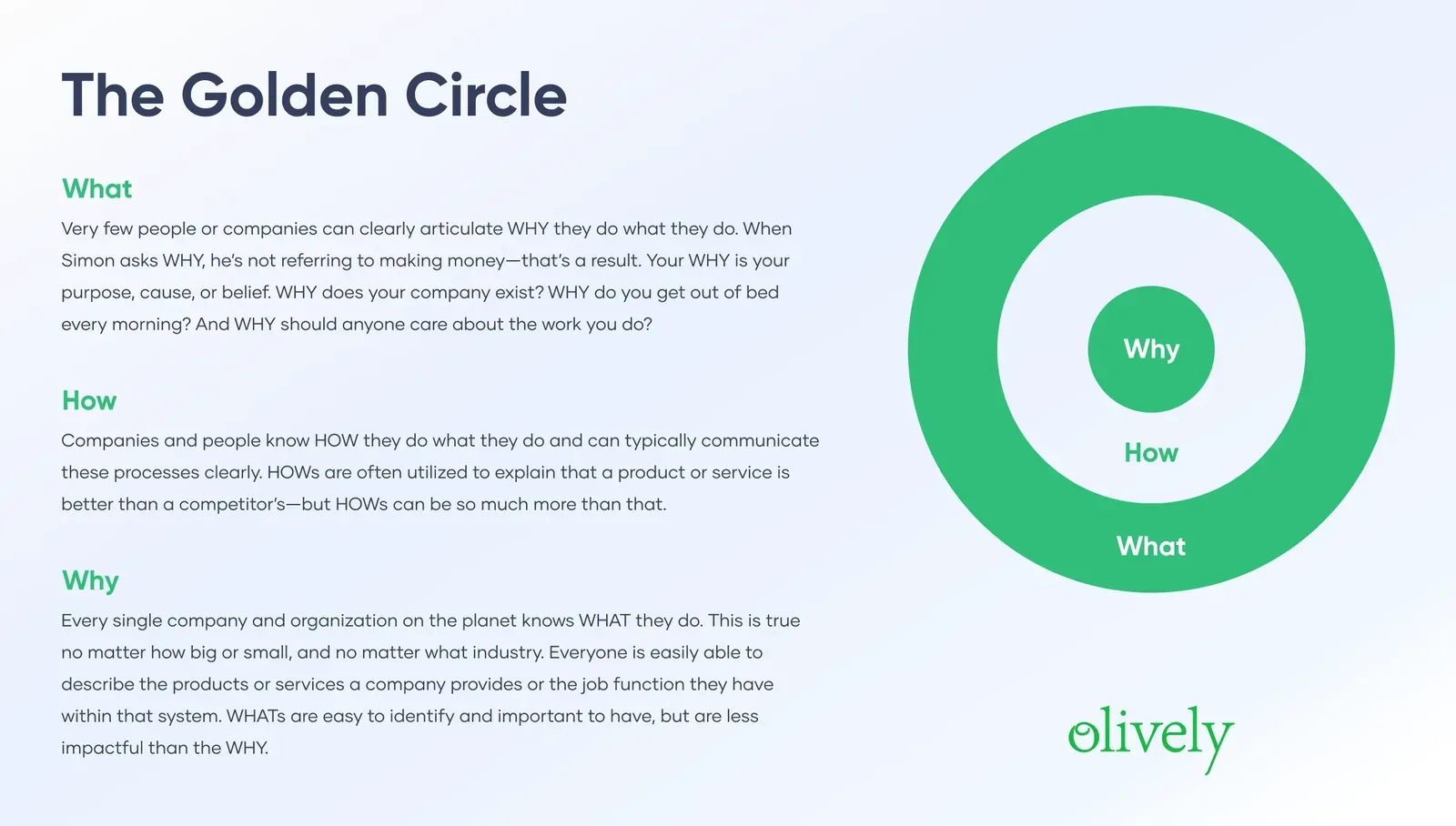
Image of the Golden Circle by Simon Sinek.
Corporate Purpose and Best Buy's Example
Hubert Joly, former chairman and CEO of Best Buy, attests to the transformative impact of defining a corporate purpose. Best Buy's purpose went beyond profit maximization to making a positive difference in the world. Joly emphasizes that a powerful corporate purpose is essential for guiding decisions and operations. Best Buy's purpose became central to its growth, inspiring employees and significantly increasing the company's share price.

Image of Best Buy's Mission.
Crafting Product-Specific Design Principles
Aligning with Jeff Bezos's missionary approach, crafting product-specific design principles becomes an integral part of manifesting a company's mission. Design principles are value statements that guide decision-making in product development. They go beyond general design principles, focusing on the specific goals a product or service should achieve for users.
Role of Design Principles
Design principles serve as a compass, providing consistency and coherence in decision-making across design teams. They take a stand on essential values, inspire empathy by emphasizing user importance, and ensure conciseness and memorability. These principles should not conflict with each other but rather work together to guide decision-making effectively.
Process of Crafting Design Principles
The process of crafting design principles involves identifying core values essential for a product or service's success. Understanding how these values impact users ensures a user-centered approach. Identifying common tradeoffs and involving various perspectives in the writing process enhances the effectiveness of design principles. Regularly discussing and reinforcing these principles within the organization ensures they remain a guiding force in decision-making.

Image of a Digital Product Team.
Conclusion
In conclusion, Jeff Bezos's advocacy for a missionary approach resonates with the concept of defining a clear mission and purpose in business. From integrating mission statements and principles to embracing a corporate why, the alignment of business strategy with a higher purpose proves transformative. Best Buy's example demonstrates the tangible impact of a well-defined corporate purpose on organizational growth. Extending this perspective to product development, crafting design principles becomes a key step in manifesting a company's mission in the products it delivers. These principles, when effectively formulated and integrated, ensure coherence and consistency in decision-making, allowing designers to focus on solving complex problems rather than engaging in unnecessary debates.
Should you require additional insights or collaborative support in integrating these principles into your digital products or refining your business strategy, do not hesitate to connect with us. I work with teams on decisions like this one.
If you're weighing a decision like this on a live product, here's the AI Reality Check.
Acquiring 24,000 users for a fintech lifestyle app — a decision that cost something — treating data consent as a trust signal rather than a friction tax.
Common questions
What is a mission-driven business?
One where the stated purpose actually constrains decisions, rather than sitting alongside them. The test is whether the mission has ever caused the company to decline something profitable.
How do you integrate purpose with strategy?
By making the purpose specific enough to rule things out. A mission that permits every possible action is a description, not a strategy.
Does purpose conflict with profit?
Not structurally, but it does constrain the route. The constraint is the point — a purpose that never costs anything is not doing any work.